
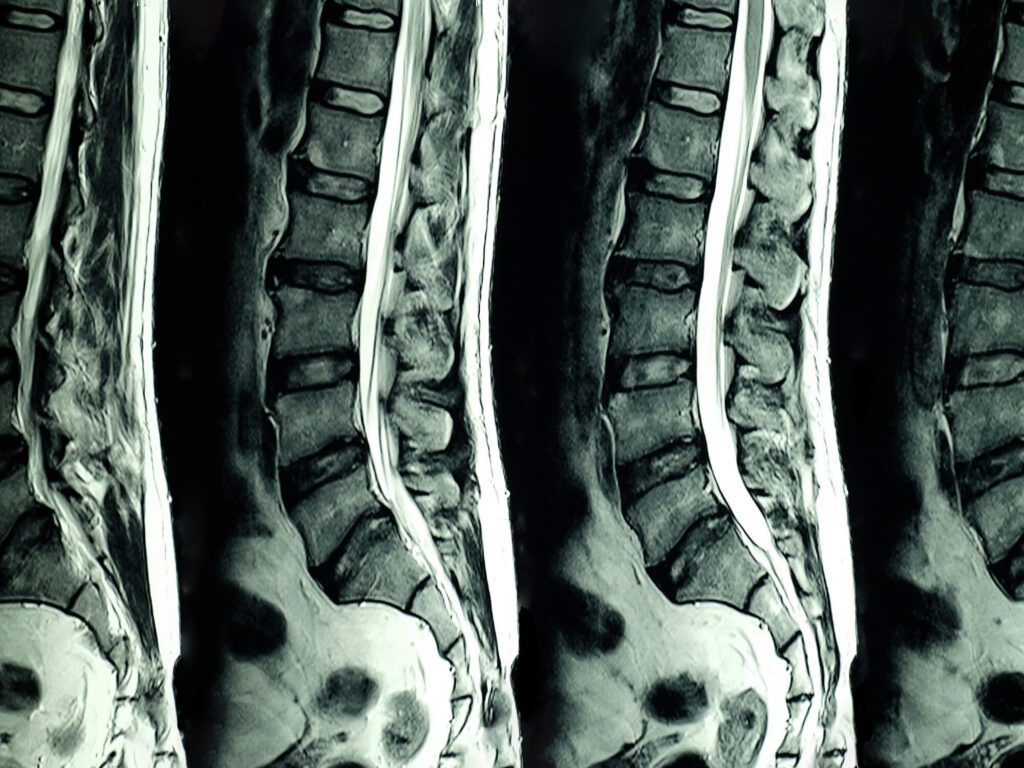
A retired engineer in his early sixties came to my clinic carrying two years of X-rays, one MRI, and a thick folder of reports he had accumulated from various consultations across the city. He had neck pain and some stiffness in his upper back. What he also had, after two years of being handed reports full of clinical language, was a deep conviction that his spine was, in his words, “completely falling apart.”
His reports mentioned degenerative changes at multiple levels, reduced disc height at C5-C6, mild spondylosis, facet joint arthropathy, and anterior osteophyte formation. Every one of those terms is real. Every one of those findings was visible on his scans. And not one of them was unusual or unexpected for a sixty-two-year-old man.
His spine was not falling apart. It was sixty-two years old.
The language of radiology reports
Here is something that almost nobody explains to patients. Radiology reports are written for doctors, not for the people being scanned. They use precise clinical terminology that is designed to be comprehensive and descriptive. The goal is to document everything visible. The goal is not to tell you how worried to be.
When a radiologist writes “degenerative changes,” they are describing a finding. They are not saying your spine is diseased or deteriorating in a way that requires urgent intervention. When they write “reduced disc height,” they are noting that a disc has lost some of the water content and height it had decades ago. When they write “mild spondylosis,” they are describing bony changes that develop as a normal part of spinal ageing.
The problem is that when patients read these words without context, they sound catastrophic. And that fear itself, separate from any structural finding, can make pain significantly worse.
What the numbers actually show
A major systematic review published in the American Journal of Neuroradiology examined imaging findings in over 3,000 people with no back pain and no spinal symptoms across different decades of life. The findings were striking. Disc degeneration was present in 37% of pain-free twenty-year-olds and in 96% of pain-free eighty-year-olds. Disc height loss increased from 24% at age twenty to 56% at age fifty. Facet joint degeneration rose from 4% at age twenty to 83% at age sixty. nih
The review’s conclusion was direct: imaging findings of degenerative changes such as disc degeneration, disc signal loss, disc height loss, disc protrusion, and facet arthropathy are generally part of the normal ageing process rather than pathological processes requiring intervention. American Journal of Neuroradiology
In other words, the findings in my patient’s folder were not evidence of a crumbling spine. They were evidence of a spine that had been in use for six decades.
Why X-rays make this worse
X-rays are particularly prone to generating this kind of unnecessary alarm because they are so commonly used as a first investigation and because bony changes show up clearly and starkly on them. Osteophytes, which are small bony projections that develop at the edges of vertebrae over time, look dramatic on an X-ray. They are also extremely common. After the age of forty, nearly all patients have anterior and lateral vertebral osteophytes visible on imaging. Most never cause a day of pain in their lives. PubMed Central
The same applies across the cervical spine. Cervical spondylosis, characterised by reduced disc height, osteophyte formation, and facet joint degeneration, affects most individuals after the fifth decade of life as a natural ageing process. Most of those people have no symptoms. Some have neck stiffness. A small number have significant nerve compression that needs treatment. The scan alone cannot tell you which category you fall into without a proper clinical examination. NCBI

What actually matters
The question that a spine surgeon is trying to answer when they look at your scan is not “are there degenerative changes?” Almost everyone over forty has degenerative changes. The question is: “do these specific findings, in this specific location, explain this specific patient’s symptoms?” That requires comparing the scan with your clinical history, the pattern of your pain, where it travels, what makes it better or worse, and what the neurological examination shows.
A scan finding that matches your symptoms and examination is meaningful. A scan finding that does not correlate with anything you are experiencing is, in most cases, background noise.
What happened to the engineer
He left my clinic that day with something more useful than any of the reports in his folder. He left with an explanation. His neck pain was real and it was coming from a combination of muscular tension and mild facet joint irritation at one level, which we could address with a targeted physiotherapy programme. The degenerative changes at other levels, the ones that had been alarming him for two years, were not contributing to his symptoms at all.
He came back six weeks later significantly better. He also came back lighter, because he had stopped carrying the folder.
A scan is a tool. Like any tool, it needs to be used correctly and interpreted by someone who understands what they are looking for. Taken out of context, imaging reports can create fear that is far more disabling than the findings themselves.

Dr. Namith Rangaswamy is an AIIMS-trained spine surgeon based in Bangalore. drnamithspine.com
If your back pain is not improving with movement or you are unsure how to get started, book a consultation with Dr Namith Rangaswamy for a personalised plan.