
A forty-year-old schoolteacher came to see me convinced she had a serious problem with her left leg. For the past three weeks, she had been waking up with a burning, shooting pain that started somewhere deep in her left buttock, ran down the back of her thigh, and by the time it reached her calf, felt like an electric shock. She had been to a general physician who had prescribed muscle relaxants and told her to rest. The pain had not budged.
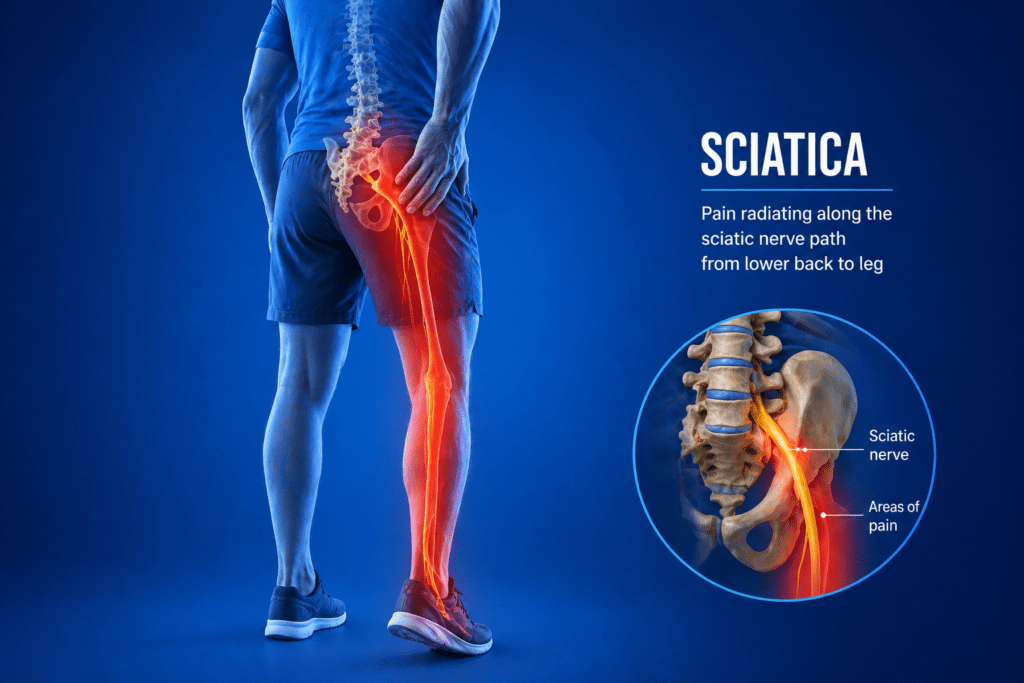
Her leg was fine. Her spine was the problem.
This is sciatica, and it confuses people enormously because the pain is felt nowhere near where it actually originates.
What the sciatic nerve actually is?
The sciatic nerve is the largest nerve in the human body. It originates from the nerve roots at L4, L5, S1, S2, and S3 in the lower spine and extends from the lower spinal cord through the buttocks, down the back of the leg, and all the way into the foot. At its widest point, it is roughly two centimetres in diameter, about the thickness of your little finger, and it runs the entire length of your lower limb. ScienceDirect
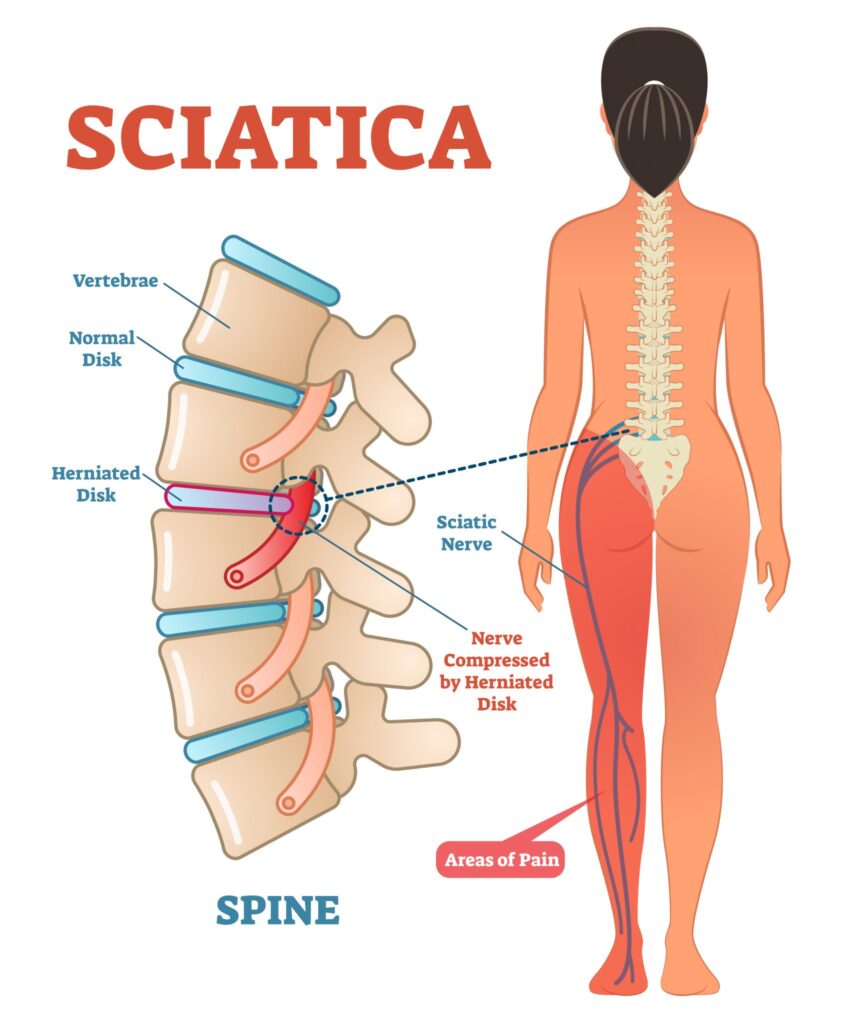
This nerve is responsible for sensation and movement through most of your leg and foot. When it or one of the nerve roots that feeds into it gets compressed or irritated in your spine, the signal of pain does not stay local. It travels along the full length of the nerve, which is why you feel it in your leg, your calf, sometimes your toes, even though nothing at all is wrong with any of those places.
Think of it like a frayed electrical wire at the base of a lamp. The problem is at the connection point, but the light flickers at the bulb.
Where the compression happens?
In most cases of sciatica, the culprit is in the lumbar spine, specifically at the L4-L5 or L5-S1 level. A disc that has bulged or herniated at one of these levels presses on the nerve root that exits the spine there. That nerve root is one of the branches that eventually becomes the sciatic nerve, so the compression in your lower back produces pain, numbness, or tingling anywhere along the path of that nerve, from the buttock all the way to the foot.
In older patients, the cause is more often spinal stenosis, which is a narrowing of the spinal canal that gradually squeezes the nerve roots as they exit. In younger patients, a herniated disc is the most frequent cause. Physiopedia
There is also a less common cause called piriformis syndrome, where a muscle deep in the buttock irritates the sciatic nerve directly as it passes beneath or through it, producing similar symptoms without any disc involvement at all. This is why a thorough examination matters. The treatment for piriformis syndrome is entirely different from the treatment for a disc herniation pressing on a nerve root.
What it actually feels like?
Sciatica has a fairly characteristic quality that distinguishes it from ordinary back pain or muscle pain. It is usually a sharp, burning, or shooting sensation rather than a dull ache. It almost always runs down one leg rather than both. It tends to follow a specific path, often the back of the thigh and calf for an L5-S1 root, or the outer shin and top of the foot for an L4-L5 root. Many people describe a feeling of numbness or pins and needles in the foot alongside the pain.
It can also vary significantly through the day. Many patients find sitting makes it dramatically worse because sitting increases the pressure inside the disc. Walking or lying flat often provides some relief. This pattern itself is a useful clue.
How common is it and will it resolve?
Between 13% and 40% of people will experience sciatica at least once during their lifetime. Most cases do improve, though the timeline is longer than with simple mechanical back pain. The nerve root, once irritated or compressed, takes time to settle down even after the underlying pressure begins to ease. clinicaltrials
Conservative management, meaning physiotherapy, nerve-settling medications, activity modification, and sometimes a targeted epidural injection, resolves the majority of cases without surgery. Surgery becomes relevant when there is progressive leg weakness, loss of bladder or bowel function, or when pain has been genuinely disabling for several months despite proper treatment.
Back to the schoolteacher
An MRI confirmed a disc herniation at L5-S1 pressing on the left S1 nerve root, which explained exactly why the pain was running down the back of her leg into her calf. She was started on a nerve pain medication, referred for physiotherapy focused on nerve mobilisation, and advised on positions that would reduce disc pressure through the day.
Eight weeks later, the electric shock sensation was gone. The occasional dull ache in her calf took another few weeks to fully fade. She did not need surgery.
The point of understanding what sciatica actually is, and why the leg hurts when the spine is the problem, is that it helps you make sense of your symptoms instead of fearing them. Once you understand the anatomy, the experience stops feeling random and starts making sense. And that, in itself, is genuinely helpful when you are in the middle of it.

Dr. Namith Rangaswamy is an AIIMS-trained spine surgeon based in Bangalore. drnamithspine.com
If your back pain is not improving with movement or you are unsure how to get started, book a consultation with Dr Namith Rangaswamy for a personalised plan.