
I Have Back Pain. Is It Safe to Exercise?
This is the question Dr Namith Rangaswamy hears most often in his Bangalore practice, and the answer almost always surprises people. When your back hurts, every instinct tells you to stop moving, rest, and protect it. For the first day or two, that instinct is reasonable. Beyond that, rest is often the worst thing you can do.

The spine is not a structure that heals by being kept still. It is a living system that depends on movement to stay nourished, strong, and resilient. The right exercise, done correctly, is not just safe when your back hurts. In most cases it is one of the most effective treatments available.
A large review of research involving nearly 31,000 people found that exercise alone reduces the risk of a back pain episode by approximately 33 percent, and exercise combined with education reduces that risk by up to 45 percent. Those are not small numbers. That is roughly one in three cases of back pain simply not happening, because someone moved their body consistently and intelligently. The key words are consistently and intelligently. Not every exercise helps, and some genuinely make things worse if you already have a problem. Internationalmedicaljournal
Why the Deep Muscles Matter More Than You Think
Running along each side of your lower spine is a small but critically important muscle called the multifidus. You cannot feel it working and you cannot see it in the mirror, but it is doing something none of your other back muscles can do: it stabilises each individual vertebra as you move, preventing the tiny shearing and rocking motions that slowly damage the discs and facet joints over time.
Here is the problem. Research has established clearly that when back pain occurs, the multifidus muscle shuts down almost immediately. It does not switch back on when the pain goes away. The dysfunction persists even after the pain has resolved, which is why back pain recurs so often in people who simply rest until they feel better and then return to normal life without any specific rehabilitation. PubMed
This is the real reason so many people experience repeated episodes of back pain. The pain goes, the muscle stays weak, and the next time the spine is loaded or moved carelessly, it has no proper protection.
The good news is that this muscle can be retrained. The exercises below are the ones that do it best.
The Exercises That Actually Help
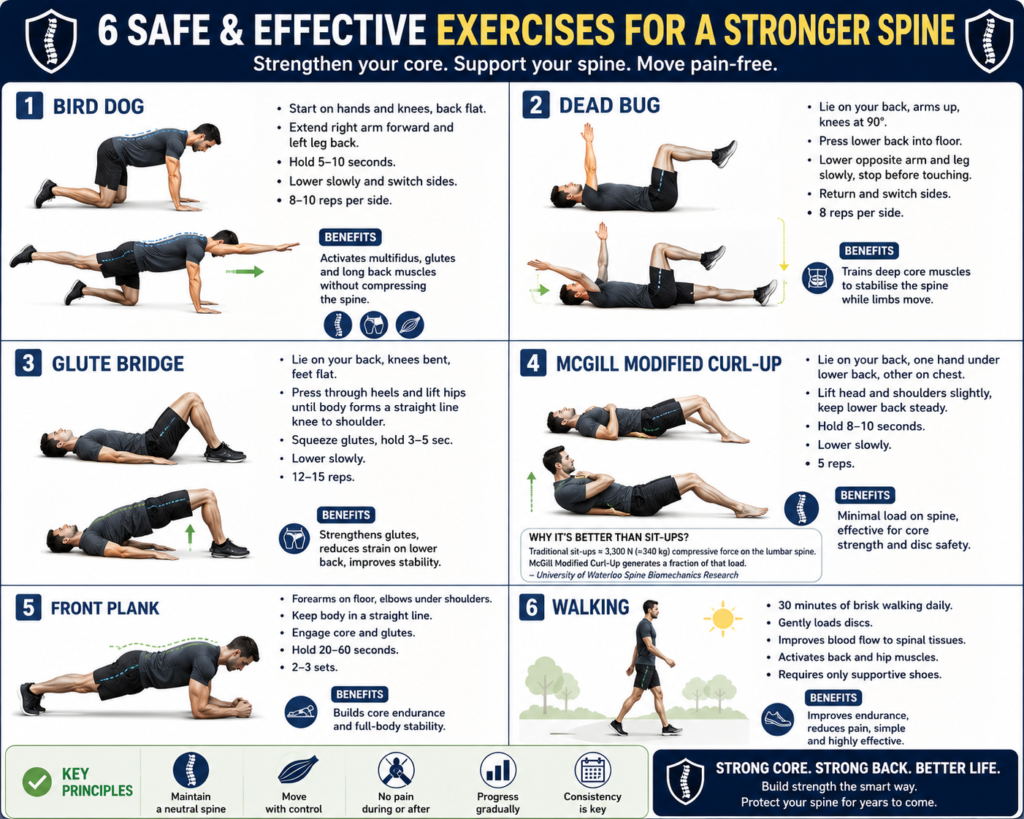
The Bird Dog
Start on your hands and knees with your back flat, like a tabletop. Keep your chin gently tucked so your neck is in line with your spine. Slowly extend your right arm forward to shoulder height while simultaneously extending your left leg back to hip height. Hold for 5 to 10 seconds. Lower both limbs slowly, without letting your back sag or rotate. Repeat on the other side. That is one repetition. Do 8 to 10 repetitions per side.
This exercise is studied more than almost any other for the spine. It activates the multifidus, the gluteals, and the long back muscles all at once, without placing any significant compressive load on the discs. It is suitable for someone in acute back pain and for a well-conditioned athlete. The only difference is the speed and the quality of control.
The Dead Bug
Lie on your back. Raise both arms toward the ceiling and lift both knees to 90 degrees, shins parallel to the floor. Press your lower back firmly into the floor and keep it there throughout the exercise. Slowly lower your right arm behind your head and straighten your left leg toward the floor at the same time, stopping just before either touches down. Return to the start and repeat on the other side. Do 8 repetitions per side.
The dead bug trains the deep abdominal muscles to stabilise the spine while the limbs move. It is excellent for people who find the bird dog uncomfortable, and it is completely safe for disc problems as long as the lower back stays in contact with the floor throughout.
The Glute Bridge
Lie on your back with your knees bent and your feet flat on the floor, hip-width apart. Press through your heels and lift your hips until your body forms a straight line from your knees to your shoulders. Squeeze your glutes at the top. Hold for 3 to 5 seconds. Lower slowly. Do 12 to 15 repetitions.
Weak gluteal muscles are one of the most underappreciated contributors to chronic back pain. When the glutes are not pulling their weight, the lower back muscles overwork to compensate. Over months and years, that overwork becomes chronic pain. The glute bridge directly addresses this, and it can be made progressively more challenging by adding a resistance band above the knees or eventually moving to a single-leg version.
The McGill Modified Curl-Up
This is not a sit-up. Lie on your back. Place one hand under the curve of your lower back to support its natural position, and keep it there throughout the movement. The other hand can rest on your chest. Raise only your head and shoulders slightly off the floor, holding your lower back steady against your hand. Hold for 8 to 10 seconds. Lower slowly. Do 5 repetitions.
The reason this replaces the conventional sit-up is a matter of physics. Research from Professor Stuart McGill’s spine biomechanics laboratory at the University of Waterloo found that traditional sit-ups place approximately 3,300 Newtons of compressive force on the lumbar spine, roughly equivalent to 340 kilograms pressing down on the lower back discs. The modified curl-up generates a fraction of that load while still effectively working the abdominal muscles. University of Waterloo
Walking
Do not underestimate this. Thirty minutes of brisk walking daily is one of the most consistently evidence-supported habits for spine health. It gently loads the discs, activates the back and hip muscles rhythmically, improves blood circulation to the spinal tissues, and requires nothing except a pair of supportive shoes. If you do nothing else on this list, walk every day.
Exercises to Avoid If You Already Have Back Pain
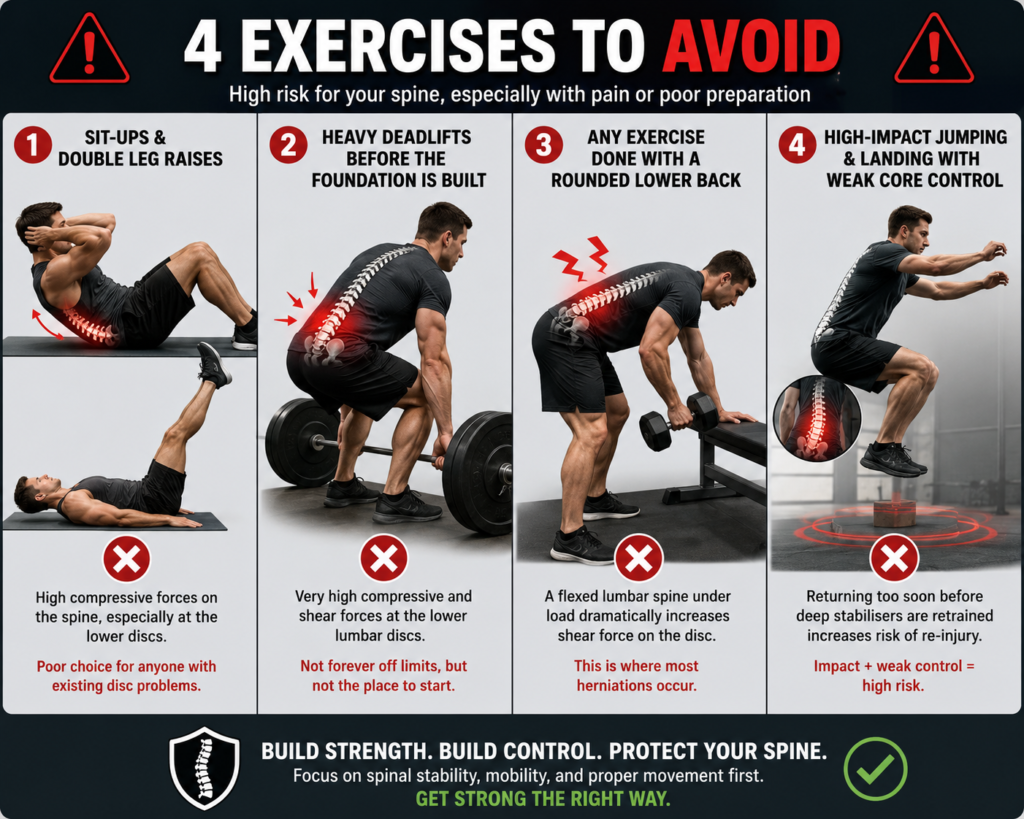
Conventional sit-ups and double leg raises. As explained above, the compressive forces are unnecessarily high and there are better alternatives. For someone with a healthy spine and no pain, sit-ups are not catastrophically dangerous. For someone with an existing disc problem, they are a poor choice.
Heavy deadlifts before the foundation is built. The deadlift is an excellent exercise for a well-conditioned spine. For someone with active back pain who has not yet done any rehabilitation work, the compressive and shear forces at the lower lumbar discs during a heavy deadlift are among the highest of any common gym exercise. Not forever off limits, but not the place to start.
Any exercise done with a rounded lower back. Whether picking something up, doing a row, or bending over a bench, a flexed lumbar spine under load dramatically increases the shear force on the posterior part of the disc, which is precisely where most herniations occur.
High-impact jumping and landing with weak core control. Running and jumping are fine for most people, but returning to them too quickly after an episode of back pain, before the deep stabilisers have been retrained, puts the spine at genuine risk of re-injury.
The Order That Matters
Most people try to go straight from back pain to the gym. The smart approach is:
- Weeks one and two: bird dog, dead bug, glute bridge, modified curl-up, daily walking only.
- Weeks three and four: add bodyweight squats, stationary cycling, light resistance exercises with good form.
- Weeks five to eight: gradually progress resistance and complexity, guided by how the spine is responding.
- After eight weeks: return to your full routine, starting well below your previous loads and rebuilding deliberately.
If you have a confirmed diagnosis of a disc herniation, nerve compression, or spinal stenosis, this progression should be supervised by a physiotherapist before you proceed independently.
When to See Dr Namith Rangaswamy
If back pain is severe enough that you cannot perform any of the exercises above comfortably, or if you experience pain, tingling, or weakness in the leg during or after exercise, a clinical assessment is the right next step before continuing. These symptoms suggest nerve involvement and need proper evaluation rather than trial and error.
Understanding your symptoms is the first step. If something here sounds familiar, book a consultation with Dr. Namith Rangaswamy or call +91 91081 04114 to get a proper diagnosis.
References
- Steffens D, et al. Prevention of Low Back Pain: A Systematic Review and Meta-analysis. JAMA Internal Medicine. 2016;176(2):199-208. https://pubmed.ncbi.nlm.nih.gov/26752509/
- Hides JA, Richardson CA, Jull GA. Multifidus muscle recovery is not automatic after resolution of acute, first-episode low back pain. Spine. 1996;21(23):2763-2769. Referenced in: https://onlinelibrary.wiley.com/doi/10.1111/papr.70044
- McGill SM. Low Back Disorders: Evidence-Based Prevention and Rehabilitation. Human Kinetics, 2002. Compression data referenced at: https://uwaterloo.ca/health/news/hes-got-our-backs
Related Pages on This Website Disc Herniation: /conditions/disc-herniation Spinal Stenosis: /conditions/spinal-stenosis Physiotherapy for Back Pain: /treatments/physiotherapy