
My Neck and Back Hurt After Sitting All Day. What Is Actually Going On?
If you finish a workday with a stiff neck, a sore lower back, or a dull ache between your shoulder blades, your posture and your workstation setup are almost certainly part of the problem. This is one of the most common complaints Dr Namith Rangaswamy sees in his Bengaluru practice, and the good news is that it is also one of the most fixable. But to fix it properly, you need to understand what is actually happening to your spine when you sit, and why the way you hold your phone matters more than most people realise.

What Happens to Your Lower Back When You Sit
Your lower spine has a natural forward curve called a lordosis. When you stand upright with good posture, that curve distributes your body weight evenly across the discs and joints of the lumbar spine. The moment you sit down, especially if you slouch or lean forward, that curve flattens or even reverses. This changes how load is distributed across your discs.
Research measuring actual pressure inside spinal discs found that sitting without back support increases disc pressure in the lower back by about 30 percent compared to standing upright. When you lean forward while sitting, for example hunching over a laptop, that pressure rises even further. In a sitting position with the back bent forward at just 20 degrees, adding 10 kilograms of load to the hands, such as holding a bag or reaching forward, increases disc pressure by about 50 percent. PubMednih
To put that in simple terms: sitting with poor posture at a desk for 8 hours is not a neutral activity. It is placing sustained, elevated mechanical stress on your spinal discs every single day. Over months and years, this contributes to disc wear, muscle imbalance, and pain.
What Happens to Your Neck When You Look Down at Your Phone
Your head weighs approximately 5 to 6 kilograms when it sits directly over your shoulders in a neutral position. The moment you tilt it forward, the effective load on your neck multiplies rapidly. A published study by spine surgeon Dr Kenneth Hansraj found that as the head tilts forward, the forces on the neck rise to 27 pounds at 15 degrees of tilt, 40 pounds at 30 degrees, 49 pounds at 45 degrees, and 60 pounds at 60 degrees of forward tilt. Most people looking at a smartphone are tilting their head between 45 and 60 degrees. Academia.edu
To put that in plain language: glancing down at your phone casually places roughly 22 to 27 kilograms of force on your cervical spine. Your neck was not designed to sustain that load for hours every day. People are spending an estimated 700 to 1,400 hours per year in this forward-tilted position, which can lead to early degeneration and increased long-term problems with the cervical spine. Academia.edu
This is why neck pain, cervical disc problems, and headaches have become so common among younger adults and even teenagers. It is not bad luck. It is physics.
How to Set Up Your Workspace So It Stops Hurting You
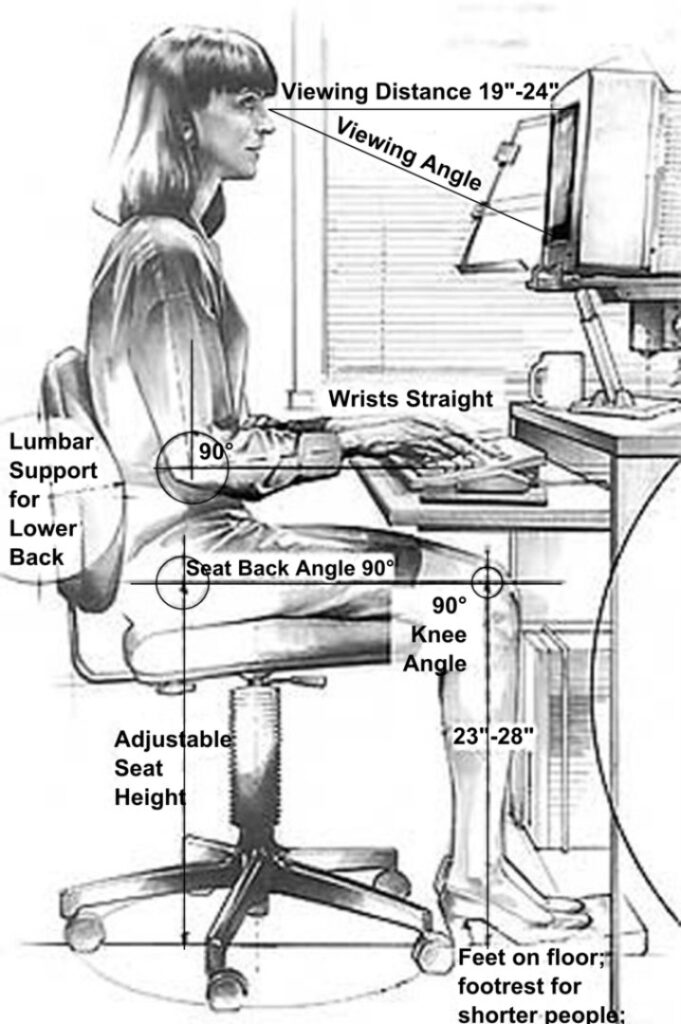
The goal of a good ergonomic setup is simple: keep the spine in its natural curves while you work, and avoid holding any one position for too long. Here is what that looks like in practice.
Your chair. Adjust the height so your feet rest flat on the floor and your knees are roughly level with your hips. Your lower back should rest against the lumbar support of the chair. If your chair has no lumbar support, roll a small towel and place it at the curve of your lower back. This one change alone reduces disc pressure significantly.
Your screen. The top of your monitor should be at eye level or very slightly below it, and roughly an arm’s length away. If you are working on a laptop, either elevate the laptop and use an external keyboard, or accept that laptop posture is inherently compromised and compensate with frequent movement breaks.
Your keyboard and mouse. Elbows should rest at approximately 90 degrees. Reaching forward or sideways repeatedly for a mouse increases shoulder and upper back tension, which in turn affects the cervical spine.
Your phone. Lift it to eye level. Every time. It sounds minor. Over 700 hours a year, it is not.
Movement breaks. No ergonomic setup eliminates the problem of staying still. Get up and move for two to three minutes every 30 to 45 minutes. Walk to get water. Do a few gentle neck rolls. This keeps the discs hydrated and the muscles from locking into fatigue patterns.
Three Exercises That Help Correct Posture
These can be done at home or in the office, with no equipment.
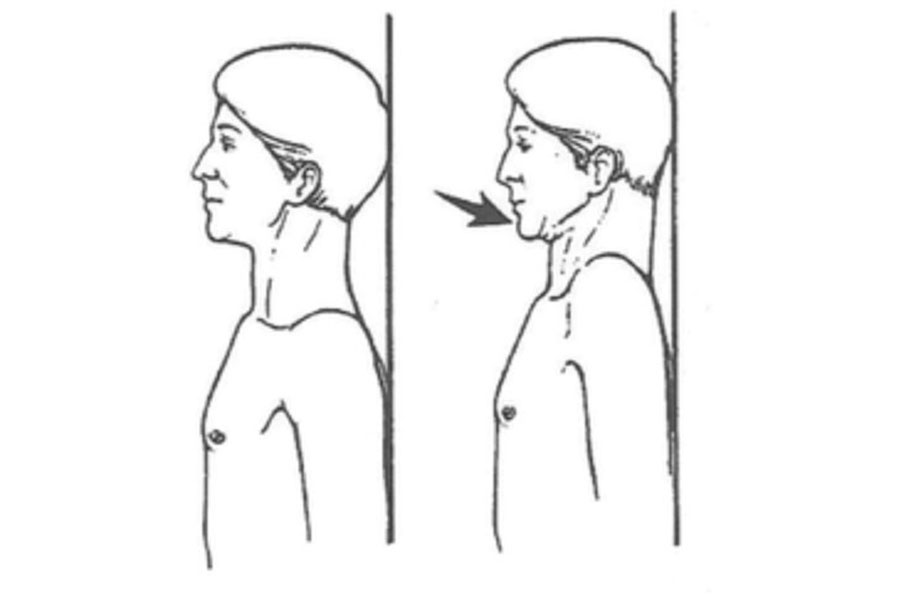
Chin tucks. Sit or stand upright. Without tilting your head up or down, gently draw your chin straight back, as if making a double chin. Hold for 5 seconds. Repeat 10 times. This directly strengthens the deep neck flexor muscles that become weak and overstretched from prolonged forward head posture.
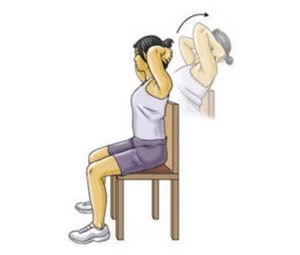
Thoracic extension over a chair back. Sit at the edge of a firm chair. Place your hands behind your head and gently lean back over the top of the chair backrest, extending your mid-back. Hold for 3 to 5 seconds and repeat 5 times. This mobilises the thoracic spine, which stiffens significantly with desk work and contributes to both neck and lower back pain.
Glute bridges. Lie on your back with knees bent and feet flat on the floor. Press your feet into the floor and lift your hips until your body forms a straight line from knees to shoulders. Hold for 5 seconds, lower slowly. Repeat 10 to 15 times. This activates the gluteal muscles and lower back extensors, which are essential for lumbar spine support and become inhibited by prolonged sitting.
What Makes It Worse Without You Realising
Carrying a heavy bag consistently on one shoulder tilts the pelvis and creates uneven spinal loading over time. Sleeping on your stomach rotates the cervical spine for hours and compresses the lumbar joints. Driving with the seat too far back forces you to reach forward for the wheel, rounding the lower back. Sitting on a sofa with your legs stretched out and your back unsupported is one of the worst sustained postures for the lumbar spine. None of these things cause immediate damage, but all of them compound over years.
When to See Dr Namith Rangaswamy
Postural correction and ergonomic changes solve the majority of desk-related neck and back discomfort within weeks. However, if you have pain that radiates down your arm or leg, numbness or tingling in the hands or feet, weakness in the grip, or pain that has not improved after six to eight weeks of addressing your posture and workstation, you need a proper spine assessment. These symptoms may point to cervical disc disease, lumbar disc herniation, or cervical spondylosis, all of which can be diagnosed accurately and treated, often without surgery.
Understanding your symptoms is the first step. If something here sounds familiar, book a consultation with Dr. Namith Rangaswamy or call +91 91081 04114 to get a proper diagnosis.
The One Change to Make Today
If you do nothing else after reading this page, lift your phone to eye level. It costs nothing, takes no effort, and over the next year will save your neck hundreds of kilograms of unnecessary cumulative load. Start there, and build from it.
References
- Roman-Liu D, Kaminska J, Tokarski T. Differences in lumbar spine intradiscal pressure between standing and sitting postures: a comprehensive literature review. PeerJ. 2023. doi:10.7717/peerj.16176. https://pubmed.ncbi.nlm.nih.gov/37872945/
- Hansraj KK. Assessment of stresses in the cervical spine caused by posture and position of the head. Surgical Technology International. 2014;25:277-279. https://pubmed.ncbi.nlm.nih.gov/25393825/
- Chan YL, Kawabata M. Comparison of In Vivo Intradiscal Pressure between Sitting and Standing in Human Lumbar Spine: A Systematic Review and Meta-Analysis. Life. 2022;12(3):457. https://pmc.ncbi.nlm.nih.gov/articles/PMC8950176/