

A fifty-eight-year-old accountant came to see me after being referred by his neurologist. He had been having trouble with his handwriting for about eight months. It had started as a minor thing, his letters becoming slightly uneven, and he had put it down to stress and long hours at a desk. Then he noticed he was occasionally dropping his phone. Then his wife pointed out that he had started walking with a subtle shuffle, leaning slightly as he moved down the corridor at home.
He had seen two doctors before the neurologist. One had suggested it might be early Parkinson’s disease. Another had attributed it to age-related changes and recommended vitamin supplements. Neither had asked about his neck.
His neck was the problem. The spinal cord running through it was being compressed, slowly and progressively, and had been for over a year. He had cervical myelopathy, and by the time he reached me, it had already caused changes that surgery could help but not fully reverse.
What cervical myelopathy actually is?
Your spinal cord runs from your brain down through a channel inside your vertebrae. In the neck, the cervical spine, it is surrounded by bone, discs, and ligaments on all sides. As we age, those structures change. Discs lose height, bone spurs form, ligaments can thicken. In some people, these changes gradually narrow the channel through which the spinal cord passes, squeezing it over months and years.
When the spinal cord itself gets compressed, rather than just the nerve roots that branch off from it, the effects are felt not just in the neck but throughout the body below the level of compression. This is what distinguishes myelopathy from the more common neck pain or cervical radiculopathy, where only a single nerve root is affected.
A pooled analysis of 19 MRI studies found that spinal cord compression was present in 24% of neurologically healthy adults, and in 35% of those aged 60 and above. Most of those people have no symptoms at all. But a proportion will go on to develop myelopathy, and when they do, the symptoms can be deceptively easy to attribute to something else entirely. NCBI
Why it gets missed for so long?
This is the part that concerns me most. A systematic review of 78 studies involving over 12,000 patients across 18 countries found that the average time from the first onset of symptoms to diagnosis was 15 months. Some research puts the average diagnostic delay at closer to two years. Misdiagnosis in primary care is a recognised part of this delay, driven largely by low awareness of the condition and its overlap with other presentations. PubMed Centralnih
The reason it gets missed is that the early symptoms of cervical myelopathy do not obviously point to the neck. The first things people notice are usually subtle: handwriting that has changed, difficulty buttoning a shirt, a grip that feels less reliable than it used to, a slight unsteadiness when walking, particularly on uneven ground or in the dark. These symptoms develop slowly, and slowly developing symptoms are easy to explain away.
By the time someone arrives with clearly abnormal reflexes, leg weakness, or balance problems bad enough to cause falls, the spinal cord has often been under pressure for a long time.
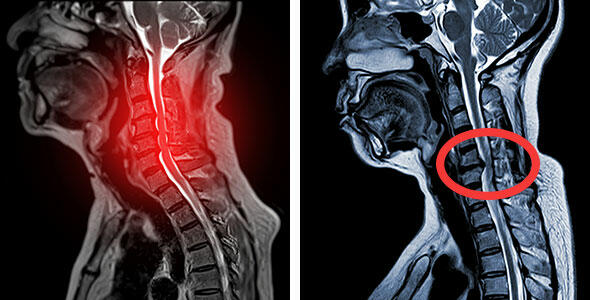
Spinal cord compression, which may be single level or usually multilevel in old age causing severe clinical symptoms
The symptoms to know
The pattern that should prompt concern is a combination of hand clumsiness or weakness alongside problems with walking or balance, particularly when there is also neck stiffness or pain. Common findings include a wide-based unsteady gait, numbness or tingling ascending through the arms or legs, loss of hand dexterity, and in severe disease, bowel or bladder dysfunction. American Academy of Family Physicians
What makes this pattern clinically distinct is that it reflects upper motor neurone involvement, meaning the spinal cord itself is affected, not just a peripheral nerve. A neurological examination, looking at reflexes, coordination, and specific tests like grip strength and the ability to walk in a straight line, can detect this pattern even before symptoms become severe.
Why timing matters so much
Cervical myelopathy is one of the conditions in spine surgery where acting early makes a genuine, measurable difference to the outcome. The spinal cord does not regenerate the way peripheral nerves do. Once it has sustained significant damage from prolonged compression, that damage can be permanent.
Evidence shows that decompression performed within four months of symptom onset is associated with meaningfully better neurological outcomes, and recovery potential diminishes significantly beyond 32 months. Surgery does not guarantee a return to full function, but it stops further deterioration and, in most patients who are treated before severe damage sets in, achieves genuine improvement. PubMed Central
The accountant I mentioned at the start had surgery. His hand function improved substantially over the months following the operation. His walking steadied. What did not fully resolve was the fine motor precision in his dominant hand, the very thing that had first brought him to a doctor eight months before he reached the right one.
He was pragmatic about it. He told me he wished he had known earlier what to look for.

What I want you to take from this post
Cervical myelopathy is not a rare condition. Roughly 1 in 40 otherwise healthy adults already meets the clinical criteria for it without knowing. It does not always start with neck pain. It often starts with something as quiet as a change in handwriting or an unexplained tendency to trip. NCBI
If you or someone you know has noticed a gradual decline in hand coordination, unexplained unsteadiness, or weakness in the legs alongside any neck symptoms, ask specifically about the cervical spine. The window for the best outcome is open for a limited time, and knowing what to look for is what keeps it open.
Dr. Namith Rangaswamy is an AIIMS-trained spine surgeon based in Bangalore. www.drnamithspine.com
If this sounds like what you’re experiencing, the sooner it’s assessed, the more options you usually have. Schedule a consultation or reach the clinic directly at +919108104114