
When a thirty-eight-year-old IT consultant came to me with severe sciatica that had not responded to three months of conservative treatment, the first thing he said after I confirmed he needed surgery was: “How long will I be out of action?”
He had a product launch in six weeks. He had two young children at home. He had heard from a colleague that spine surgery meant months of recovery, drains, a long scar down the back, and weeks in hospital. He was already dreading it.
I told him he would likely be walking the corridor the same evening as his surgery and going home the following day. He looked at me like I had said something improbable.
That reaction is still very common, and it reflects how dramatically spine surgery has changed in the last two decades while public perception has largely stayed in the past.
What people imagine when they hear “spine surgery”?
The image most people carry is of traditional open surgery: a long incision down the centre of the back, muscles cut and pulled aside to expose the spine, a significant amount of blood loss, several days in hospital, and a recovery measured in months. That image is not wrong. It is just increasingly outdated for many of the conditions we treat.
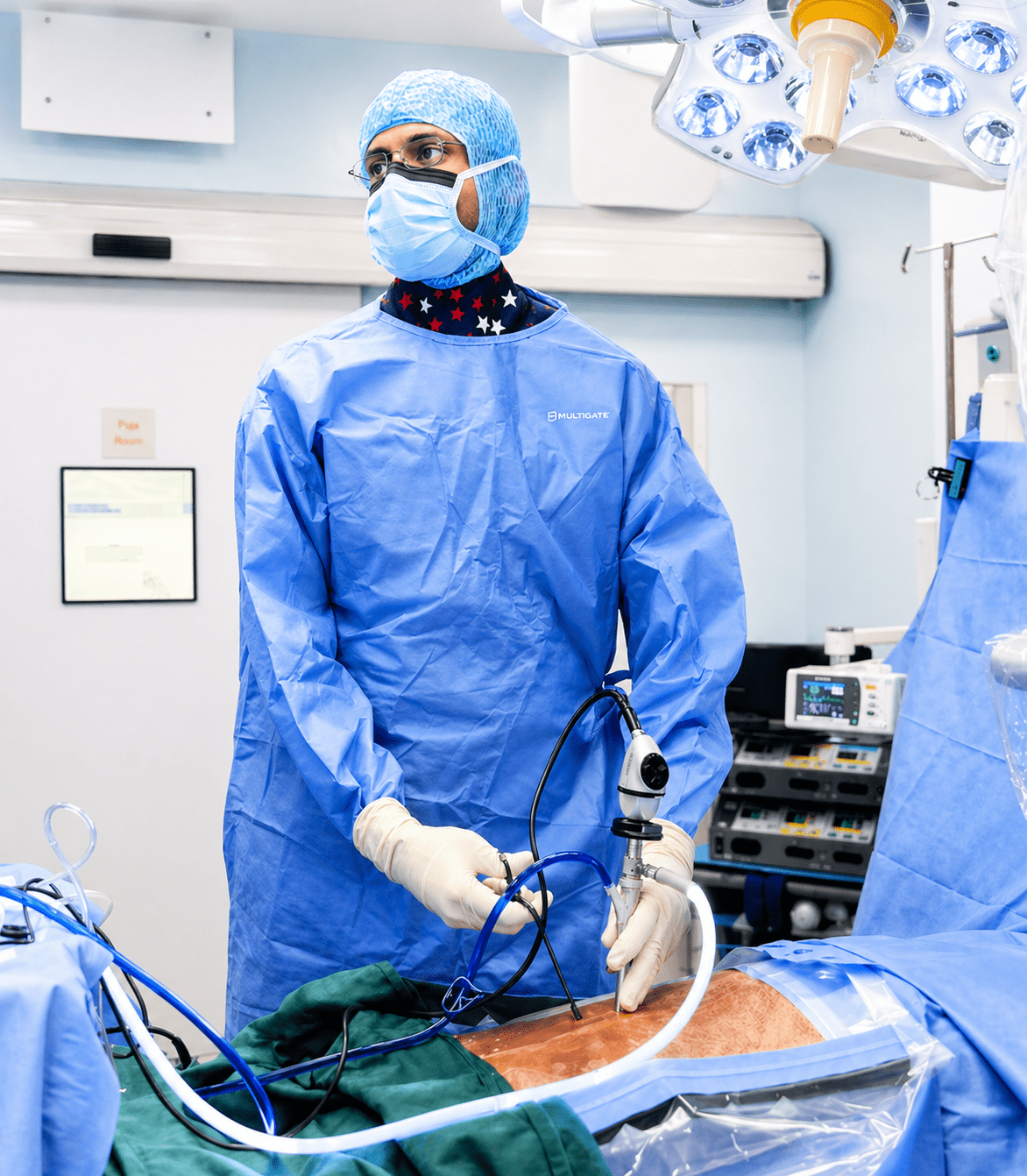
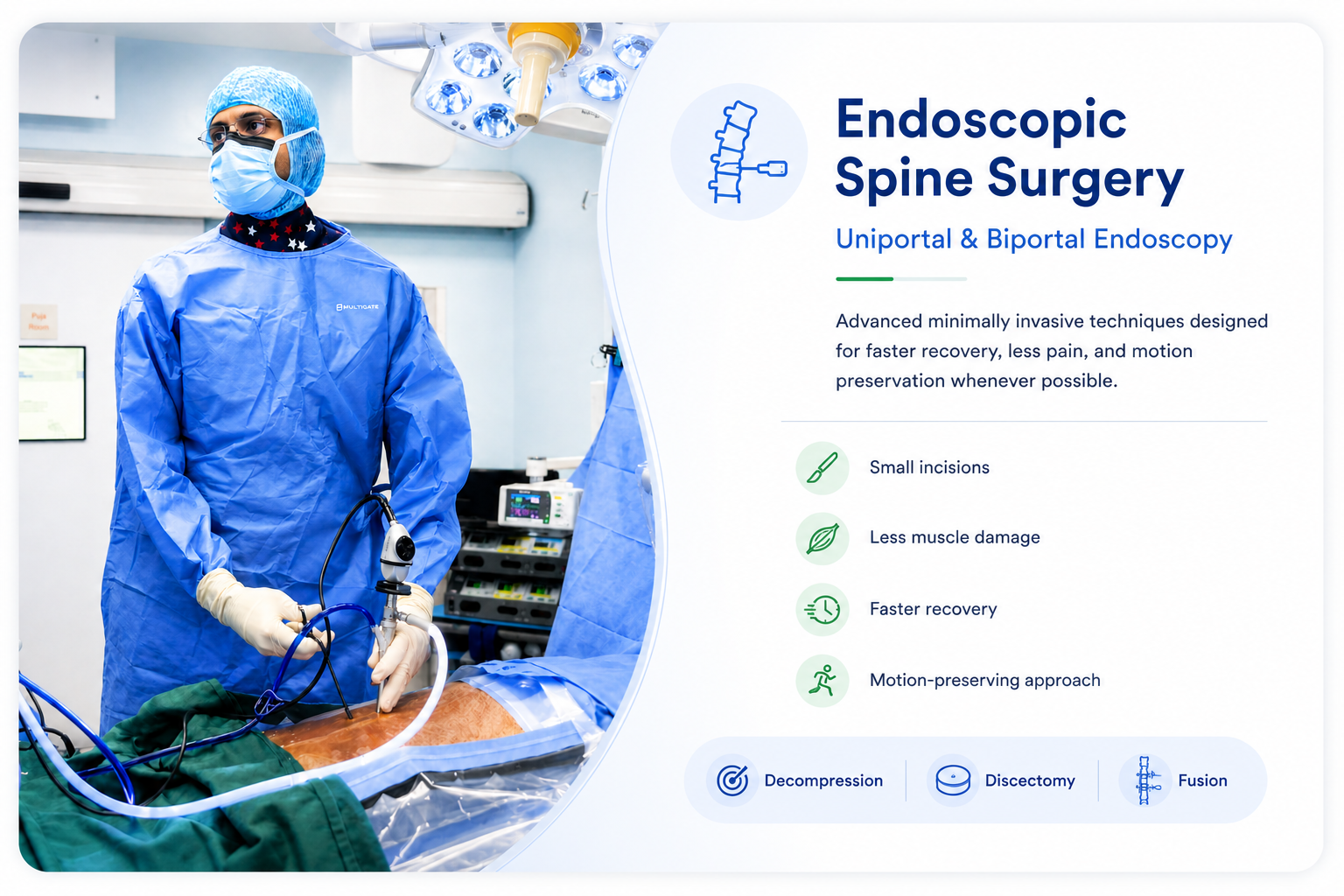
The approach that has replaced it for a growing range of spinal problems is minimally invasive spine surgery, which patients and surgeons both commonly call keyhole surgery. The principle is straightforward. Instead of a large opening, we work through one or two small incisions, often less than two centimetres, using a tube that gently parts the muscle fibres rather than cutting through them. A high-definition camera and a powerful operating microscope give us a magnified, illuminated view of the surgical field, and we use precision instruments through that same corridor to decompress the nerve, remove the disc fragment, or stabilise the segment.
The muscle is moved aside, not destroyed. When the procedure is done, it springs back. That single difference is responsible for almost every recovery advantage that follows.
What the evidence shows
This is not marketing language. The data on keyhole spine surgery versus open surgery is consistent across multiple well-designed studies and systematic reviews.
A large matched study comparing minimally invasive and open lumbar spinal fusion found that minimally invasive surgery was associated with shorter hospital stay, higher patient satisfaction at three months, and fewer reoperations at twelve months. The JNS
For disc surgery specifically, comparative studies show that microendoscopic discectomy results in significantly shorter hospital stay, less blood loss, and earlier return to work compared to open discectomy, with equivalent success rates of approximately 90% for both approaches. PubMed Central
Blood loss during keyhole procedures is substantially lower. Infection rates are lower because there is less exposed tissue. Post-operative pain scores are lower because the muscles have not been stripped. And patients get home faster, not because we are rushing them out, but because their bodies have simply not been through the same degree of surgical trauma.
What conditions it works for
Keyhole surgery has become the standard approach at my centre for a wide range of spinal problems. A herniated disc causing sciatica, spinal canal stenosis causing leg pain and weakness, certain types of spinal instability requiring fusion, and decompression surgery for nerve root compression can all be addressed this way in appropriate patients.
It is not a universal solution. Complex deformities, multi-level disease requiring extensive reconstruction, or cases where anatomy makes a small corridor genuinely unsafe may still require a more open approach. The goal is always to choose the technique that best serves that specific patient. For the majority of straightforward spinal surgery cases, keyhole is not just an option, it is what I would choose for my own family member.
What recovery actually looks like
The IT consultant I mentioned at the start had a percutaneous endoscopic discectomy. His incision was less than a centimetre. He was walking the same evening. He went home the next morning. He was back at his desk, working from home, within ten days, and he attended his product launch.
For a desk job, most patients are back to work within two weeks of a minimally invasive discectomy. Resumption of normal activities including physical exercise typically happens around six weeks. HSS
That timeline is not exceptional. It is what we see routinely. The patients who struggle to believe it are the ones who prepared themselves for something much worse based on what spine surgery used to look like.
One thing worth saying plainly
Keyhole surgery is an approach, not a guarantee. The same principles apply as with any surgery: the indication has to be right, the timing has to be right, and the technique has to match the problem. Minimally invasive surgery done for the wrong reason produces a small scar and a bad outcome. The technique matters far less than the judgement behind choosing it.
What has genuinely changed is that when surgery is the right answer, the physical cost of getting it done is now considerably lower than it was. The recovery is faster, the disruption to normal life is less, and the fear that surrounds the word “surgery” can, in many cases, be substantially reduced.
That is worth knowing before you walk into a consultation convinced that saying yes to an operation means months on your back.
Dr. Namith Rangaswamy is an AIIMS-trained spine surgeon based in Bangalore. www.drnamithspine.com
If you’re weighing your surgical options, getting a clear, evidence-based opinion matters. Book an appointment with Dr. Namith Rangaswamy or call +91 91081 04114.