
So, You Want a Healthier Spine. Where Do You Even Start?
Most people only think about their spine when something hurts. A sharp pull while picking up a bag. A dull ache after a long day at the desk. A morning stiffness that takes an hour to shake off. Sound familiar? If it does, you are not alone. Nearly 619 million people worldwide were living with low back pain in 2020, close to 10 percent of the entire global population, and that number is expected to reach 843 million by 2050. Back pain is the single biggest cause of disability on the planet. The Lancet
But here is the thing. Most of it is preventable. And a great deal of it is reversible. This section of Dr Namith Rangaswamy’s website exists for one reason: to give you clear, honest, practical information about how to look after your spine, whether you are 16 or 70, a desk worker or a professional athlete, someone who has never had back pain or someone who has been managing it for years.
Your Spine Is Doing More Than You Think
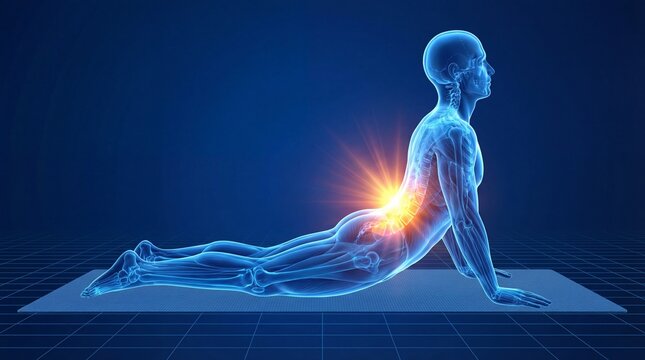
Before we talk about what to do, it helps to understand what your spine actually is. Your spine is made up of 33 bones called vertebrae, stacked on top of each other from your skull to your tailbone. Sitting between each pair of vertebrae are 23 discs, which act like shock absorbers. These 23 discs together make up roughly 25 to 33 percent of the entire length of your spine. Think of each disc as a small, firm cushion filled with a gel-like centre. They absorb impact, allow you to bend and twist, and stop your vertebrae from grinding against each other. NCBI
The problem is that discs have no direct blood supply. They get their nutrients from the fluid that moves in and out of them when you move. When you sit still for hours, or when you move badly and repeatedly over years, those discs slowly lose their hydration and resilience. That is when things start to go wrong.
Your spine also has a set of natural curves: a forward curve in the neck, a backward curve in the mid-back, and a forward curve in the lower back. These curves are not a design flaw. They are what allow the spine to absorb load efficiently. When posture, lifestyle or injury disrupts those curves, the load distribution becomes uneven, and that is where pain and damage begin.
The Numbers That Should Make You Think
Research involving over 21,000 people found that exercise alone reduces the risk of developing low back pain by 33 percent, and that exercise combined with education reduces the risk by a further 27 percent. That is not a minor benefit. That is one in three cases of back pain that simply does not happen, because someone moved their body regularly and understood how to protect their spine. ResearchGate
Nearly 39 percent of all disability caused by low back pain worldwide is directly linked to three modifiable factors: occupational exposures, smoking, and a high body mass index. Modifiable means changeable. These are not things that happen to you without warning. They are things that build up gradually, and they can be addressed. nih
What This Wellness Section Covers
This guide has 17 pages, each one written to answer the real questions people ask about spine health. Not textbook answers. Practical ones.
You will find pages on posture and how to set up your workspace without hurting yourself, on which exercises actually help and which ones to avoid if you already have back pain, on yoga, swimming, running and gym training, on what you eat and how you sleep, on managing spine pain alongside stress and anxiety, and on specific guidance for school children, working professionals, athletes, pregnant women, older adults, and those recovering from spine surgery.
Every page is built around evidence. Where there are real numbers from published research, you will find them here, explained in plain language.
Dr Namith Rangaswamy’s Approach
Dr Namith Rangaswamy is an internationally trained complex spine surgeon, sports spine surgeon and pediatric spine surgeon based in Bangalore. His approach to spine care is built on one core principle: surgery is not the first answer. For the vast majority of spine conditions, the right combination of lifestyle change, targeted exercise, and non-surgical treatment will produce excellent outcomes without an operation.
When surgery is necessary, Dr Namith’s preference is always for motion-preserving procedures such as cervical disc replacement, lumbar disc replacement, and vertebral body tethering for appropriate candidates, protecting movement rather than fusing it away. Endoscopic and minimally invasive techniques are used wherever possible to reduce recovery time and surgical risk.
But this section is not about surgery. It is about helping you build a spine that does not need it.
When to Stop Reading and See Someone
This guide is for people with general back and neck discomfort, those who want to prevent problems, and those managing chronic pain alongside their medical care. If you have any of the following, please stop reading and book an appointment: pain or tingling shooting down the arm or leg, weakness in the hands or feet, loss of bladder or bowel control, pain after a fall or accident, or back pain accompanied by unexplained weight loss or fever. These symptoms need professional assessment, not a wellness article.
One Last Thing Before You Begin
Your spine has supported you through everything. Every step you have taken, every hour you have sat at a desk, every time you have lifted something heavier than you should have. It has done all of that without complaint, until it could not. The pages ahead are about giving it the support it deserves in return. Start with whichever topic matters most to you right now.
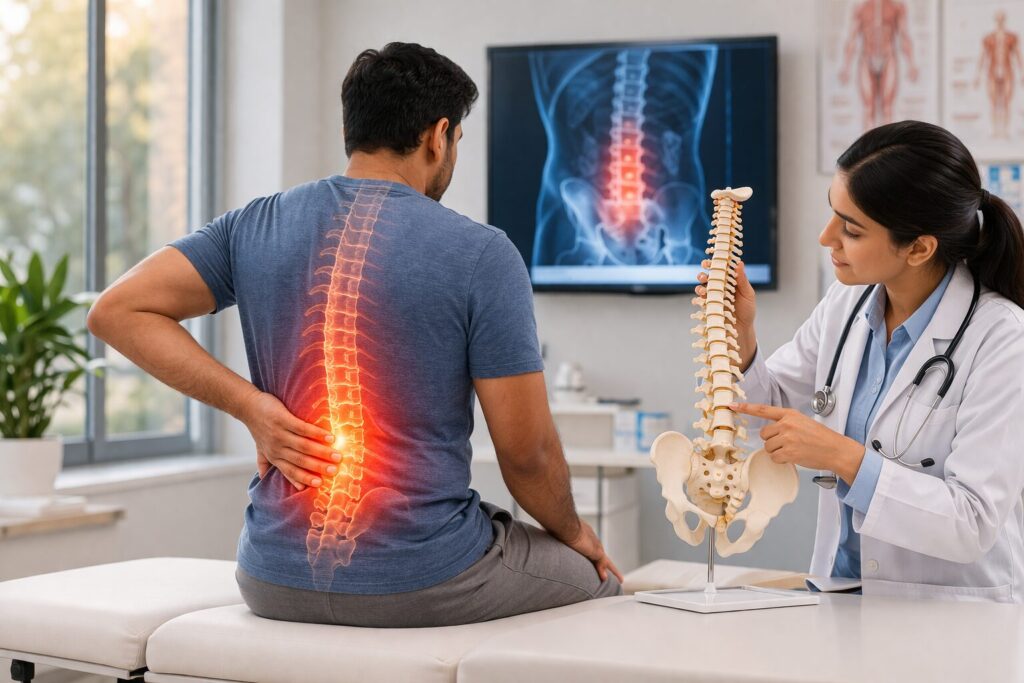
Understanding your symptoms is the first step. If something here sounds familiar, book a consultation with Dr. Namith Rangaswamy or call +91 91081 04114 to get a proper diagnosis.
References
- GBD 2021 Low Back Pain Collaborators. Global, regional, and national burden of low back pain, 1990 to 2020. The Lancet Rheumatology. 2023. https://www.thelancet.com/journals/lanrhe/article/PIIS2665-9913(23)00133-9/fulltext
- Waxenbaum JA, Reddy V, Futterman B. Anatomy, Back, Intervertebral Discs. StatPearls. Updated January 2026. https://www.ncbi.nlm.nih.gov/books/NBK470583/
- Steffens D, et al. Exercise for the Prevention of Low Back Pain: Systematic Review and Meta-Analysis of Controlled Trials. JAMA Internal Medicine. 2016. https://www.researchgate.net/publication/320507602
- Wu A, et al. Global low back pain prevalence and years lived with disability. Annals of Translational Medicine. 2020. https://www.ncbi.nlm.nih.gov/pmc/articles/PMC10234592/