
What is Cervical Myelopathy?
Cervical myelopathy is the most serious consequence of cervical spine disease. It occurs when the spinal cord itself, not just a nerve root, is compressed within the neck. Unlike a pinched nerve, which affects one limb or region, spinal cord compression can affect the arms, legs, bladder, and bowel function simultaneously.
It is the most common cause of spinal cord dysfunction in adults over 50, yet it is frequently under-recognised in its early stages because symptoms develop gradually and are often attributed to ageing or other conditions.

Who Gets It and Why?
Cervical myelopathy is most commonly caused by:
- Cervical spondylosis – progressive disc degeneration, osteophyte formation, and ligament thickening narrow the spinal canal over years
- Ossified Posterior Longitudinal Ligament (OPLL) – calcification of the ligament behind the vertebral bodies, common in East Asian populations and increasingly recognised in India
- Cervical disc herniation – a large central disc prolapse compressing the cord
- Congenital narrow spinal canal – individuals born with a narrower canal have less reserve and develop myelopathy earlier
What Does It Feel Like?
The symptoms of cervical myelopathy are often subtle at first and progress slowly:
- Clumsy hands – difficulty with fine motor tasks such as buttoning shirts, writing, or handling small objects
- Unsteady gait – a feeling of imbalance or heaviness in the legs, worsening on uneven ground
- Weakness in the arms or legs
- Neck pain and stiffness – though some patients have surprisingly little pain
- Electric shock sensation down the spine on bending the neck forward (Lhermitte’s sign)
- Bladder urgency or difficulty in more advanced cases
- Deterioration in handwriting is often an early and overlooked sign
How Is It Diagnosed?
Diagnosis requires a combination of clinical assessment and imaging:
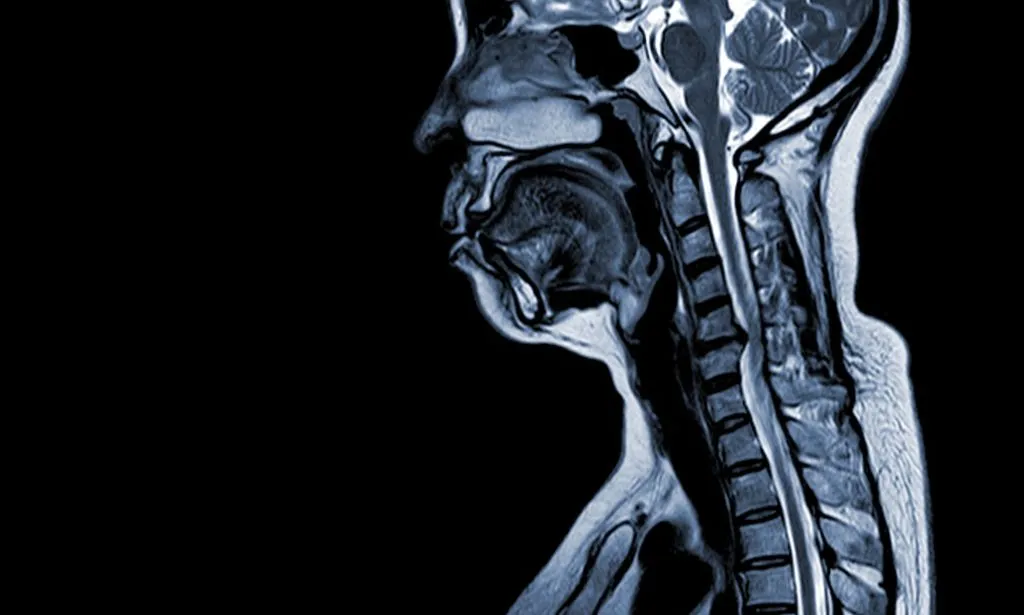
- MRI of the cervical spine is essential – it identifies the degree of cord compression and any signal change within the cord (myelomalacia), which indicates established injury
- CT scan delineates bony anatomy and is critical for surgical planning, particularly in OPLL
- Neurophysiological studies (SEP, MEP) help assess cord function objectively
How Is It Treated?
Cervical myelopathy does not reliably improve without surgery once significant cord compression is established. Unlike radiculopathy, watchful waiting carries the risk of irreversible neurological deterioration.
Surgical decompression, relieving pressure on the spinal cord, is the definitive treatment. The approach (anterior, posterior, or combined) is determined by the number of levels involved, the direction of compression, the alignment of the cervical spine, and patient factors. Commonly performed procedures include:
- Anterior cervical discectomy and fusion (ACDF) for one or two level disease
- Cervical disc replacement in selected younger patients
- Cervical laminoplasty or laminectomy with fusion for multilevel disease
Outcomes are best when surgery is performed before irreversible cord damage occurs. Recovery of function is meaningful in the majority of patients when decompression is timely.
If you or someone you know is experiencing clumsiness, balance problems, or weakness alongside neck symptoms, a prompt spine specialist assessment is strongly recommended.
Self-Check at Home
The Hand Grip and Release Test (Myelopathy Hand Test): Open and close your hand as quickly as possible for 10 seconds. Count how many times you can fully open and fully close your fist. A normal result is approximately 20 or more cycles in 10 seconds. Fewer than 20 cycles, particularly if one hand is significantly slower than the other, suggests possible cervical myelopathy affecting fine motor control.
The Tandem Gait Test: Walk in a straight line, placing one foot directly in front of the other (heel to toe) for 10 steps, as if walking a tightrope. This requires intact coordination pathways in the spinal cord. Significant wobbling, the need to hold a wall, or inability to complete the test without losing balance suggests possible myelopathy affecting the cord pathways to the legs.
The 10-Second Step Test: Count how many steps you can take in 10 seconds. Most people without myelopathy can manage 18 or more steps. Fewer than 18 may suggest lower limb involvement from spinal cord compression.
The Handwriting Check: Compare your handwriting from a year ago to today. Deteriorating handwriting — becoming smaller, more cramped, or less controlled — is one of the earliest and most commonly overlooked signs of cervical myelopathy affecting fine hand function.
The Button Test: Attempt to button and unbutton a shirt or jacket. Time how long it takes. Difficulty with small buttons, particularly if this has worsened over months, is a practical indicator of hand dysfunction from cervical myelopathy.
Unsure about your symptoms? Our free Spine Self Check takes less than two minutes and gives you a clearer picture before your consultation.
Motion-Preserving Surgical Options
Cervical Laminoplasty: Laminoplasty is the definitive motion-preserving surgical treatment for multilevel cervical myelopathy. The laminae are opened and held in a hinged-open position using small plates, permanently expanding the spinal canal and decompressing the spinal cord without removing any bone or fusing any levels. The cervical spine retains meaningful range of motion postoperatively, and the risk of adjacent segment disease is eliminated.
Laminoplasty is particularly well suited to patients with:
- Multilevel spondylotic myelopathy (3 or more levels involved)
- Preserved or neutral cervical lordosis (alignment)
- OPLL at multiple levels
Cervical Disc Replacement: For myelopathy caused by compression at one or two disc levels, anterior disc replacement decompresses the cord while maintaining motion — a significant advantage over fusion in younger, active patients.
Understanding your symptoms is the first step. If something here sounds familiar, book a consultation with Dr. Namith Rangaswamy or call +91 91081 04114 to get a proper diagnosis.